In contemporary discourse, the word “Hindu” is frequently explained through a simplified historical claim — that it originated merely as a geographical label derived from the river Sindhu and later altered through pronunciation.
Traditional sources, however, present a deeper understanding.
Across the Sanskrit intellectual tradition — including Smritis, Agamic texts, and later philosophical works — the word “Hindu” is associated not merely with geography but with qualities and conduct.
A traditional definition attributed to Vriddha Smriti describes:
“Hinsaya duyate yascha sadacharatatparah
Vedagopratimasevi sa hindumukhashabdabhak.”
One whose heart is pained by violence, who is devoted to righteous conduct, and who serves the Vedas and sacred tradition is understood as a Hindu.
This definition shifts the discussion from location to orientation toward Dharma.
Another traditional description emphasises spiritual foundations:
“Omkara mulamantradhyah punarjanma drdhashayah
Gobakto bharataguruh hindu hinsanadushakah.”
A Hindu is one who accepts Omkara as foundational, has conviction in rebirth, reveres the Guru lineage, and regards violence as blameworthy.
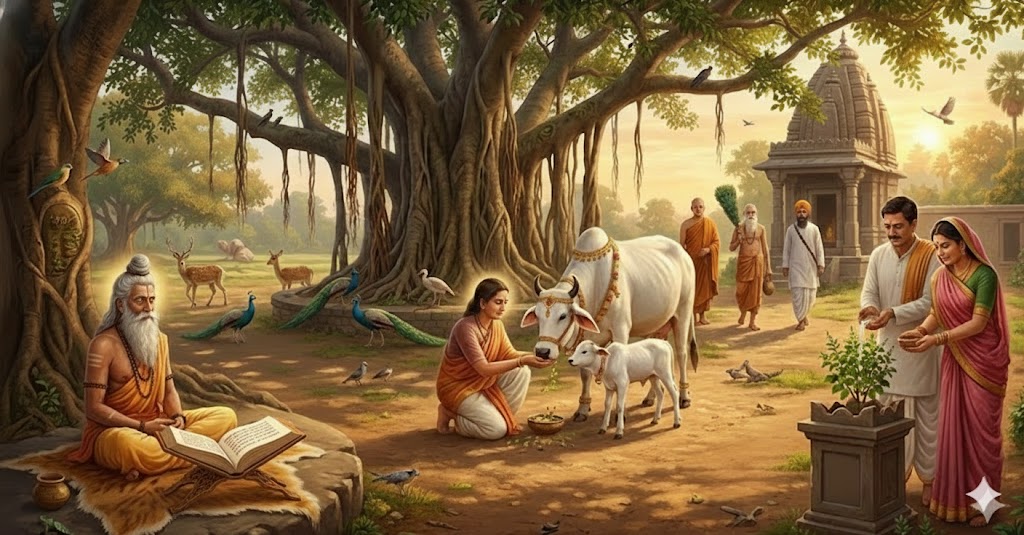
Classical Dharmic literature consistently connects the term “Hindu” with values such as:
- Sensitivity toward harm
- Commitment to righteous conduct (sadachara)
- Reverence for Vedic knowledge
- Acceptance of rebirth
- Respect for Guru-parampara
- Alignment with cosmic order (Rta / Dharma)
Linguistic traditions within Sanskrit also show that phonetic transformations such as “S” becoming “H” occur internally. Examples like asmi → aham illustrate natural linguistic evolution, suggesting that the term developed within the Dharmic linguistic ecosystem itself.
Traditional texts further describe the civilizational space of Dharma:
“Himalayam samarabhya yavad indu sarovaram
Tam devanirmitam desham hindusthanam prachakshate.”
(Brihaspati-Agama)
The divine land stretching from the Himalayas to the Indu ocean is known as Hindusthan.
Such references indicate that the term carries civilizational, cultural, and philosophical meaning — not merely geographic usage.
Seen through this lens, “Hindu” becomes a description of orientation toward life: ethical restraint, spiritual inquiry, reverence for knowledge, and recognition of interconnected existence.
In the modern context, this distinction is significant. Identity shaped only through simplified narratives can obscure intellectual depth. Scriptural exploration restores continuity.
Know Your Dharm presents these themes carefully, drawing from traditional teachings so that readers can move beyond commonly repeated assumptions and understand Dharmic concepts with clarity and responsibility.
.