
Core Principles of Sanatan dharmaPart-1 – VarnAshram Dharm
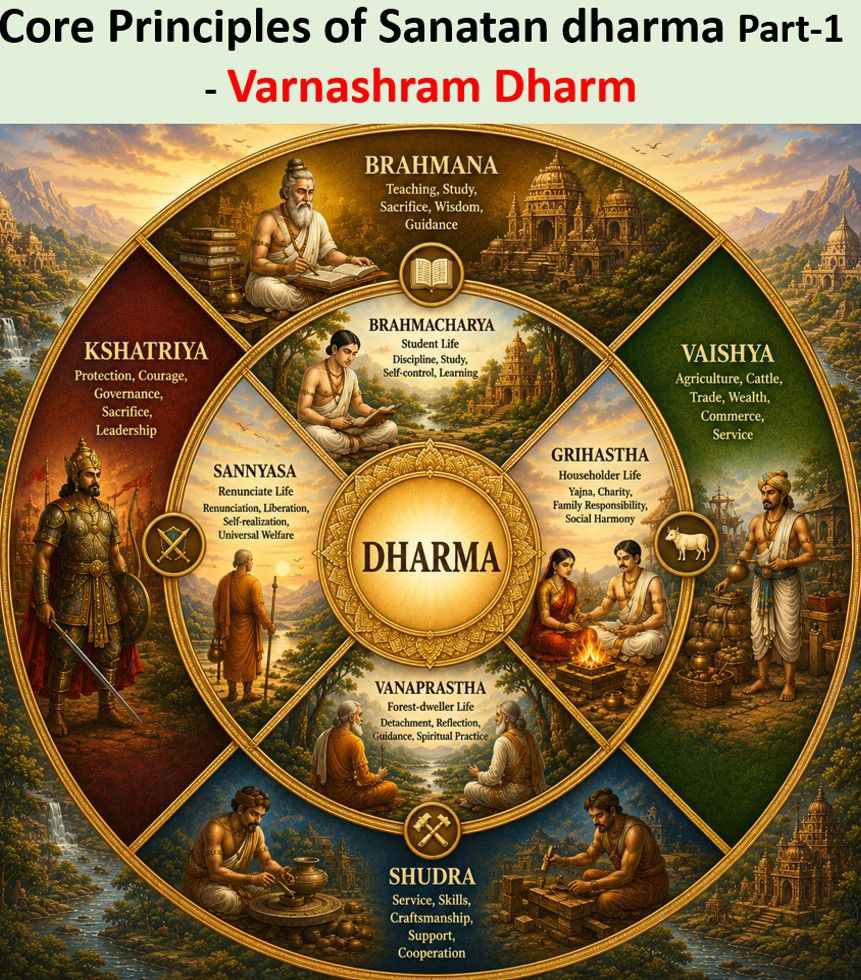
Introduction: The Distinction Between Dharma and Sectarian Beliefs (Mat-Panth) There is an immense state of confusion in the world today regarding the definition and interpretation of the word ‘Dharma’. Generally, people mistake various historical beliefs, denominations, or sects (panths) for Dharma itself. However, in the Sanatana Vedic tradition, Dharma is not a transient sect or creed established by any specific individual. Knowing and adhering to these foundational, unrefutable doctrines of Sanatana Dharma is of paramount importance for every follower. In this series, we will systematically examine these universal and irrefutable core doctrines, the foremost of which are outlined below: Varnashrama Dharma Siddhanta (The Doctrine of Social and Life-Stage Order) Ashtanga Yoga Siddhanta (The Doctrine of the Eightfold Path of Yoga) Ekadeva aur Bahudeva Siddhanta (The Doctrine of Monotheism and Polytheism) Punarjanma Siddhanta (The Doctrine of Rebirth) Avatara Siddhanta (The Doctrine of Divine Incarnation) Panchabhuta aur Panchadeva Siddhanta (The Doctrine of Five Elements and Five Deities) Purushartha Chatushtaya Siddhanta (The Doctrine of the Four Ultimate Life Pursuits) Yuga Chatushtaya Siddhanta (The Doctrine of the Four Cosmic Eras) Srishti, Sthiti, Samhriti, Nigraha, aur Anugraha Siddhanta (The Doctrines of Cosmic Creation, Sustenance, Dissolution, Control, and Grace) Karma-Yoni aur Bhoga-Yoni Siddhanta (The Doctrine of the Realm of Action and Realm of Experience) In this first part, we shall strictly analyze the true essence of the Varnashrama Dharma Siddhanta. In reality, Varnashrama Dharma is itself the true definition and foundational canvas of Sanatana Dharma. Varnashrama Dharma is “The Dharma”, The Sanatan Dharma! Defining Dharma in the Vaisheshika Darshana, Rishi Kanada declares: Yato ‘bhyudaya-nihshreyasa-siddhih sa dharmah. (Vaisheshika Darshana 1.1.2 cite: 423, 424) “That which ensures the attainment of material/worldly elevation (Abhyudaya) as well as ultimate spiritual well-being or liberation (Nihshreyasa, meaning Moksha), is true Dharma.” The most unique characteristic of Sanatana Dharma is that it never forcefully imposes a single rigid rule uniformly upon everyone. On this earth, the specific duties (Dharma) of every individual are naturally determined in accordance with their age, responsibilities, Varna (temperamental categorization by birth), Ashrama (stage of life), gender, and immediate circumstances. This mathematically balanced cosmic arrangement is known as Varnashrama Dharma. The Threefold Authorities of Dharma-Siddhi: Shrauta, Smarta, and Shishtachara Varnashrama Dharma cannot be interpreted arbitrarily based on personal whims. For its validation and precise decision-making (Dharma-Siddhi), the scriptures have established three absolute authorities (Pramanas)—Shruti (Vedas), Smriti, and Shishtachara. It is explicitly declared in the Anushasana Parva of the Mahabharata (162.20) that although the authorities appear threefold, they ultimately illuminate the exact same undivided, singular Dharma. The inner relationship and nature of these three parameters are structured through the following analytical tables: Shrauta and Smarta Dharma The Meaning of ‘Shista’ and ‘Shishtachara’ The practical execution of Varnashrama Dharma remains alive and dynamic solely through Shishtachara (the conduct of the elite realized sages). In sacred literature, the word ‘Shista’ is never used in the superficial modern sense of merely looking polite, polished, or formally educated. From a strict linguistic and grammatical perspective, the word Shista is derived by combining the verbal root ‘Shish’ (Shish-Dhatu) with the classical past-participial suffix ‘Kta’ (Kta-Pratyaya). Those highly advanced spiritual entities, rishis, and masters who exist on this earthly plane in every single Manvantara specifically to preserve, manifest, and defend the boundaries of cosmic order are defined as Shista. Svayambhuva Manu and the Saptarshis are the foundational archetypes of Shista. The Matsya Purana (145.36) delineates the eight absolute metrics (behavioral characteristics) of Shishtachara: Danam satyam tapo ‘lobho vidyejya pujanam damah. (Matsya Purana 145.36) This implies that Dana (charity), Satya (truthfulness), Tapas (penance), Alobha (absolute freedom from greed), Vidya (sacred knowledge), Ijya (performance of sacrifices), Pujanam (devotional worship), and Dama (perfect control over the sensory organs)—the person in whom these eight attributes are naturally and immutably established is a true Shista, and their regular behavioral conduct is defined as Shishtachara. Whenever the true essence of Dharma becomes obscured by social decay or external geographical crises across historical timelines, the scripturally aligned, unblemished conduct of these Shista souls serves as the absolute light navigating society. Varnashrama: The only way for ideal Cosmic Balance and Social Harmony In Sanatana Dharma, human society is scientifically structured into four Varnas (Brahmin, Kshatriya, Vaishya, Shudra) and individual human life is systematically phased into four sequential Ashramas (Brahmacharya, Grihastha, Vanaprastha, Sannyasa). This absolute division is completely free from any stain of malice, hatred, or structural discrimination; its foundational architecture is entirely philosophical, biological, and socio-economically scientific. The structural perfection of this divine system is anchored upon the following cosmic realities: Guaranteed Inherent Livelihood and Economic Immunity: In the authentic Sanatana framework, every human being’s livelihood was securely reserved and structurally guaranteed right from their very birth. Because the economic rights of every single group were absolute within cottage industries, agriculture, traditional crafts, and specific service guilds, there was zero scope for financial destitution, systemic unemployment, or the psychological anxiety that plagues modern competitive societies. The Equitable Balance of Accountability: This framework completely insulates a human being from unnatural, toxic societal competition and overwhelming mental burdens. Every individual is commanded to execute duties strictly within the boundaries of their ordained sphere, automatically maintaining unshakeable psychological harmony and community peace. Harnessing Natural, Biological Diversity: While it is true that we all possess physical bodies composed of the exact same five elements (Panchamahabhutas) and our inner animating consciousness (Atman) is identical, the stark practical reality of the physical universe is that every individual is born with completely distinct mental faculties, physical capacities, and innate biological tendencies (Prakriti). Instead of foolishly trying to suppress or equalize these natural variations, the Varnashrama matrix flawlessly organizes them to ensure supreme social equilibrium. In the Srimad Bhagavad Gita (18.45), Bhagavan Sri Krishna declares this eternal doctrine: Sve sve karmanyabhiratah samsiddhim labhate narah. (Srimad Bhagavad Gita 18.45) “Devoted intently to his own innate, natural duties, a human being effortlessly climbs to the peak of ultimate spiritual perfection.” Here, there is absolutely no space for the chaotic, unscientific assertion of “everyone having a right to do everything,” which historically succeeds
Core Principles of Sanatan dharmaPart-1 – VarnAshram Dharm Read More »