Sanatan Dharm

The Meaning of Dharma

Introduction:  The Meaning of Dharma Why it Matters?   Few words in human civilization carry as much depth and philosophical significance as the Sanskrit word Dharma. Yet paradoxically, it is also one of the most misunderstood concepts today. In modern discussions the word is often translated as “religion,” but this translation does not capture the true scope and meaning of Dharma within the wisdom traditions of Sanatan civilization. In the Vedic worldview, Dharma does not merely refer to a belief system, a ritual practice, or membership in a religious group. Instead, it refers to the fundamental principles that sustain life, maintain order in the universe, and guide human conduct toward harmony and spiritual growth. Understanding Dharma is essential for understanding the entire framework of Sanatan philosophy. The teachings of the Vedas, Upanishads, Puranas, and the Bhagavad Gita all rest upon the concept of Dharma. Without grasping what Dharma truly means, it becomes difficult to appreciate the deeper purpose of these scriptures and the philosophy they convey. In Sanatan tradition, human life has four fundamental goals known as the Purusharthas: Dharma, Artha, Kama, and Moksha. Among these four, Dharma stands first because it provides direction and balance to the other three. When Dharma is properly understood and practiced, wealth and desires remain balanced and ultimately lead the individual toward the highest goal of life—spiritual liberation. Dharma: The Principle That Sustains the Universe The Sanskrit word Dharma is derived from the root “धृ” (dhṛ), which means to sustain, to support, or to uphold. From this perspective, Dharma can be understood as that which sustains existence and maintains the harmony of the universe. In nature every entity has an intrinsic property that defines its function. Fire has the property of heat. Water possesses the quality of coolness and fluidity. The sweetness of sugar is its natural characteristic. These inherent qualities represent the Dharma of those substances. Similarly, human beings also possess a natural Dharma. Truthfulness, compassion, self-discipline, and righteousness are considered the natural qualities that sustain human society and promote harmony in life. Thus Dharma is not a concept invented by human beings. It represents the natural order embedded within existence itself. Just as physical laws govern the material universe, moral and spiritual principles govern human life and social harmony. This understanding reveals why Dharma cannot be limited to the meaning of religion. Religions may represent belief systems or traditions followed by communities, but Dharma refers to universal principles that apply to all beings and operate throughout creation. Dharma and the Four Purusharthas Sanatan philosophy explains that human life is guided by four fundamental pursuits known as the Purusharthas: Dharma – righteous conduct and the principles of harmonyArtha – wealth, resources, and material well-beingKama – desires, emotions, and the enjoyment of lifeMoksha – liberation from the cycle of birth and death Among these four, Dharma occupies the foundational position. Artha and Kama are natural aspects of human life and are not rejected in the Vedic worldview. Human beings require material resources for survival, and they naturally experience desires and emotional aspirations. However, Sanatan wisdom emphasizes that both wealth and desires must remain guided by Dharma. When wealth is acquired through dishonesty, exploitation, or injustice, it ultimately leads to conflict and suffering. Likewise, when desires are pursued without restraint or moral awareness, they create imbalance within the individual and society. But when Artha and Kama are pursued in accordance with Dharma, they contribute to a balanced life. Wealth becomes a tool for sustaining society and supporting noble actions, while desires remain aligned with ethical and spiritual values. Through this balanced approach, the human mind gradually becomes purified and prepared for the pursuit of the highest goal—Moksha, liberation from ignorance and suffering. The Real Purpose of Human Life One of the most profound insights of Sanatan philosophy is that the ultimate purpose of human life is not merely material success or sensory pleasure. While prosperity and happiness are part of life, they are not its final objective. The Bhagavata Purana explains this beautifully by stating that Dharma should not be practiced merely for the sake of acquiring wealth, and wealth itself should not be pursued solely for sensory enjoyment. Even pleasure is not meant merely for the gratification of the senses. Instead, the true purpose of human life is tattva-jijnasa, the inquiry into the ultimate truth of existence. This inquiry begins when a person starts reflecting upon deeper questions such as: Who am I? What is the nature of the universe? What is the source of consciousness? What is the purpose of life? When a person lives according to Dharma, the mind gradually becomes calm, disciplined, and pure. This mental clarity enables deeper reflection and spiritual inquiry. Through knowledge and contemplation, one begins to realize the true nature of the self. This realization leads to Moksha—the liberation from ignorance and the cycle of repeated birth and death. The Characteristics of Dharma in Human Conduct Ancient scriptures describe numerous virtues that reflect the presence of Dharma in human conduct. These virtues form the ethical foundation of a harmonious society. The Manusmriti identifies ten important characteristics of Dharma: patience, forgiveness, self-control, non-stealing, purity of body and mind, control of the senses, wisdom, knowledge, truthfulness, and absence of anger. Similarly, the Bhagavata Purana describes a larger set of qualities associated with Dharma. These include compassion, austerity, simplicity, humility, devotion, contentment, service to saints and teachers, and sharing resources with others in a spirit of generosity. These virtues demonstrate that Dharma is not merely a philosophical idea. It is a practical way of living that shapes human character. When individuals cultivate these qualities, they contribute to peace within themselves and harmony within society. Dharma and the Laws of Nature Another way to understand Dharma is by comparing it with the laws of nature. Nature operates according to precise and consistent principles. The earth moves in its orbit, seasons follow predictable cycles, and seeds produce plants according to their inherent nature. Human life also operates within a similar moral

The Meaning of Dharma Read More »
whatismoksha 300 kb

Moksha: The Ultimate Aim of Human Life, Yet most Misunderstood!

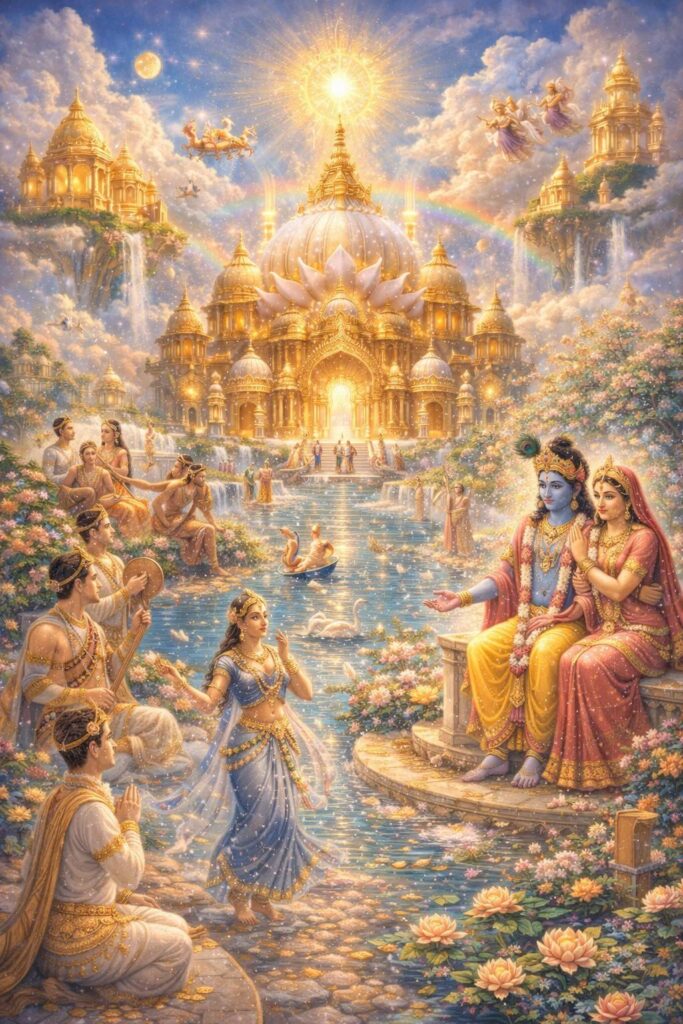
In the vast landscape of Sanatan Dharma, the word “Moksha” is often utilized as a casual synonym for tranquility. Yet, for the serious seeker who examines the Granths or listens to the Vani of realized Mahatmas, Moksha reveals itself not as a mood, but as a permanent ontological shift. It is the definitive conclusion to the soul’s journey through Samsara—the relentless cycle of arrival and departure. To understand Moksha is to understand the very mechanics of existence. It requires us to move beyond popular sentiment and embrace the precise definitions laid down in our ancient texts.   1. The Swarga Delusion: Why Heaven is a Temporary Bondage A primary hurdle in spiritual clarity is the tendency to conflate Moksha with Swarga (Heaven). While modern interpretations often paint them with the same brush, the Shastras provide a starkly different architecture for each. The Economy of Punya: Think of Swarga as a “celestial luxury resort”. Entry is purchased through the accumulation of Punya (merit) via rituals, charity, and ethical conduct. The Exhaustion of Credit: In the Bhagavad Gita, Shri Krishna provides a sobering warning: once the “balance” of Punya is spent, the soul is evicted from this celestial height and propelled back into the Mrityu Loka (the world of death). The Zero-Balance Mandate: Unlike Heaven, Moksha is not a reward for good deeds. It is the state of having a “Zero Account Balance”—where neither Paap (sin) nor Punya (merit) remains to bind the soul to a physical form. While more Punya leads to heaven and more Paap leads to lower realms, Moksha is the cessation of the need to travel at all 2. The Present Reality: Understanding Jivanmukti Moksha is frequently misunderstood as a “post-death” occurrence. While the final shedding of the physical shell is a reality, the Shastras illuminate a state known as Jivanmukti—liberation while the breath still flows. By definition, Moksha is the detachment from all bondages and desires. If a seeker achieves this internal detachment today, they are termed a “Jivanmukta”. Even in our current era, such realized souls exist. They inhabit the human form not because they are compelled by past Karma, but as instruments of Divine work. They move through the world, but like a lotus in water, they remain untouched by its cravings. 3. The Saayujya Paradox: Union or Oblivion? Within the classification of liberation, Saayujya Moksha stands as the most enigmatic. It is often described through the profound analogy of a drop of water returning to the vastness of the ocean. The Loss of Individuality: Upon this union, the drop (the soul) ceases to have a separate existence. There is no body, no sense organs, and no distinct “I” to perceive the experience. The Seeker’s Dilemma: This total dissolution into the Divine Essence creates a spiritual paradox. If “you” no longer exist, who is left to witness the liberation? It is this very prospect of “disappearance” that makes many devotees approach Saayujya with hesitation. 4. The Devotee’s Choice: Why Bhakti Transcends Mukti If Moksha is the Param Purushartha (the supreme goal), why do the most distinguished devotees of Lord Krishna or Lord Shiva often spurn it? The answer lies in the unique “Rasa” (taste) of the Bhakti tradition. Tasting vs. Becoming: A devotee values the “Taste of the Divine” over the state of “Becoming the Divine.” The Rejection of the Five Liberations: The Srimad Bhagavatam records that pure devotees often reject all five forms of Mukti—Sayujya (union), Salokya (same realm), Samipya (proximity), Sarupya (same form), and Sarshti (equal opulence)—if such a state ends their ability to serve. The Bee and the Nectar: For the lover of God, the “Separation” required for love is far more precious than the “Union” offered by Moksha. They would rather remain a bee, perpetually hovering to sip the nectar, than become the flower itself and lose the ability to taste its sweetness. 5. The Intervention of Grace: Shri Krishna’s Promise Because we carry the accumulated Karma of billions of human births, it is a mathematical impossibility for a soul to achieve a “Zero Balance” through self-effort alone. This is the most critical realization in Sanatan Dharma. In the Bhagavad Gita, Shri Krishna offers the ultimate assurance: for the soul that completely surrenders (Saranagati), He personally destroys the mountain of Paap and Punya accumulated across eons. He bestows Moksha not as a calculated reward, but as a gift of Grace, customized to the devotee’s deepest heart’s wish—whether that be eternal service or total absorption. Conclusion: Beyond the Mrityu Loka Moksha remains the most profound subject of our Dharma precisely because it touches the eternal. It is the exit from Mrityu Loka (the world of death) and the entry into the Unchanging. Whether one seeks the silence of Sayujya or the sweetness of Bhakti, the path begins with unlearning the myths and ends with the Grace of the Almighty.

Moksha: The Ultimate Aim of Human Life, Yet most Misunderstood! Read More »

Who Is a Hindu? Scriptural Insights Beyond the Popular Narrative

In contemporary discourse, the word “Hindu” is frequently explained through a simplified historical claim — that it originated merely as a geographical label derived from the river Sindhu and later altered through pronunciation. Traditional sources, however, present a deeper understanding. Across the Sanskrit intellectual tradition — including Smritis, Agamic texts, and later philosophical works — the word “Hindu” is associated not merely with geography but with qualities and conduct. A traditional definition attributed to Vriddha Smriti describes: “Hinsaya duyate yascha sadacharatatparahVedagopratimasevi sa hindumukhashabdabhak.” One whose heart is pained by violence, who is devoted to righteous conduct, and who serves the Vedas and sacred tradition is understood as a Hindu. This definition shifts the discussion from location to orientation toward Dharma. Another traditional description emphasises spiritual foundations: “Omkara mulamantradhyah punarjanma drdhashayahGobakto bharataguruh hindu hinsanadushakah.” A Hindu is one who accepts Omkara as foundational, has conviction in rebirth, reveres the Guru lineage, and regards violence as blameworthy. Classical Dharmic literature consistently connects the term “Hindu” with values such as: Sensitivity toward harm Commitment to righteous conduct (sadachara) Reverence for Vedic knowledge Acceptance of rebirth Respect for Guru-parampara Alignment with cosmic order (Rta / Dharma) Linguistic traditions within Sanskrit also show that phonetic transformations such as “S” becoming “H” occur internally. Examples like asmi → aham illustrate natural linguistic evolution, suggesting that the term developed within the Dharmic linguistic ecosystem itself.   Traditional texts further describe the civilizational space of Dharma: “Himalayam samarabhya yavad indu sarovaramTam devanirmitam desham hindusthanam prachakshate.”(Brihaspati-Agama) The divine land stretching from the Himalayas to the Indu ocean is known as Hindusthan. Such references indicate that the term carries civilizational, cultural, and philosophical meaning — not merely geographic usage. Seen through this lens, “Hindu” becomes a description of orientation toward life: ethical restraint, spiritual inquiry, reverence for knowledge, and recognition of interconnected existence. In the modern context, this distinction is significant. Identity shaped only through simplified narratives can obscure intellectual depth. Scriptural exploration restores continuity. Know Your Dharm presents these themes carefully, drawing from traditional teachings so that readers can move beyond commonly repeated assumptions and understand Dharmic concepts with clarity and responsibility.   .

Who Is a Hindu? Scriptural Insights Beyond the Popular Narrative Read More »