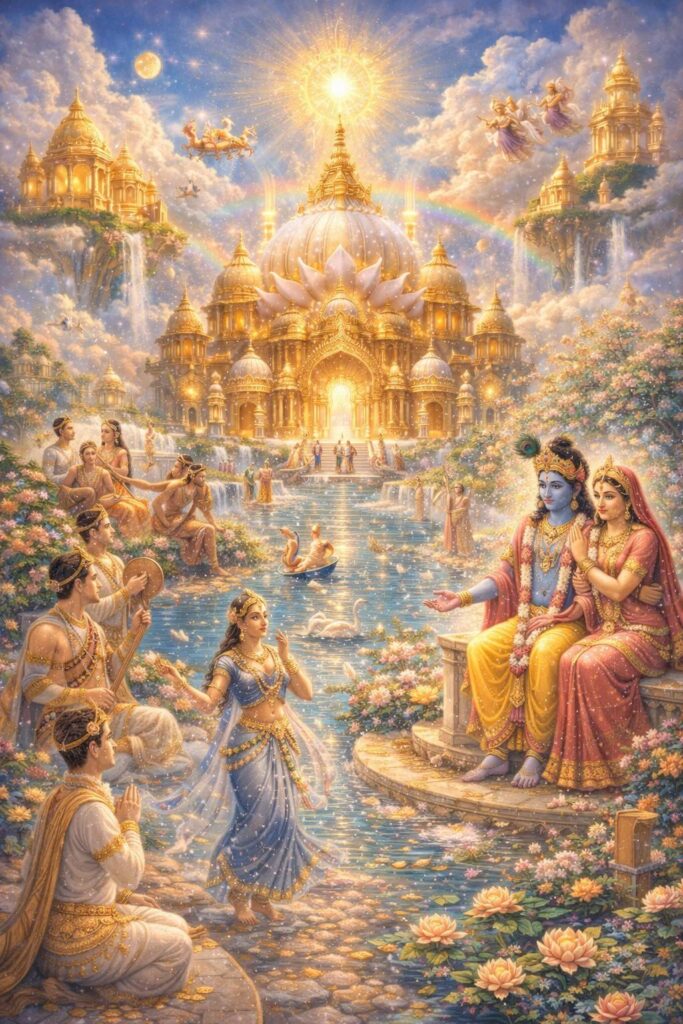
In the vast landscape of Sanatan Dharma, the word “Moksha” is often utilized as a casual synonym for tranquility. Yet, for the serious seeker who examines the Granths or listens to the Vani of realized Mahatmas, Moksha reveals itself not as a mood, but as a permanent ontological shift. It is the definitive conclusion to the soul’s journey through Samsara—the relentless cycle of arrival and departure.
To understand Moksha is to understand the very mechanics of existence. It requires us to move beyond popular sentiment and embrace the precise definitions laid down in our ancient texts.
1. The Swarga Delusion: Why Heaven is a Temporary Bondage
A primary hurdle in spiritual clarity is the tendency to conflate Moksha with Swarga (Heaven). While modern interpretations often paint them with the same brush, the Shastras provide a starkly different architecture for each.
The Economy of Punya: Think of Swarga as a “celestial luxury resort”. Entry is purchased through the accumulation of Punya (merit) via rituals, charity, and ethical conduct.
The Exhaustion of Credit: In the Bhagavad Gita, Shri Krishna provides a sobering warning: once the “balance” of Punya is spent, the soul is evicted from this celestial height and propelled back into the Mrityu Loka (the world of death).
The Zero-Balance Mandate: Unlike Heaven, Moksha is not a reward for good deeds. It is the state of having a “Zero Account Balance”—where neither Paap (sin) nor Punya (merit) remains to bind the soul to a physical form. While more Punya leads to heaven and more Paap leads to lower realms, Moksha is the cessation of the need to travel at all
2. The Present Reality: Understanding Jivanmukti
Moksha is frequently misunderstood as a “post-death” occurrence. While the final shedding of the physical shell is a reality, the Shastras illuminate a state known as Jivanmukti—liberation while the breath still flows.
By definition, Moksha is the detachment from all bondages and desires. If a seeker achieves this internal detachment today, they are termed a “Jivanmukta”. Even in our current era, such realized souls exist. They inhabit the human form not because they are compelled by past Karma, but as instruments of Divine work. They move through the world, but like a lotus in water, they remain untouched by its cravings.
3. The Saayujya Paradox: Union or Oblivion?
Within the classification of liberation, Saayujya Moksha stands as the most enigmatic. It is often described through the profound analogy of a drop of water returning to the vastness of the ocean.
The Loss of Individuality: Upon this union, the drop (the soul) ceases to have a separate existence. There is no body, no sense organs, and no distinct “I” to perceive the experience.
The Seeker’s Dilemma: This total dissolution into the Divine Essence creates a spiritual paradox. If “you” no longer exist, who is left to witness the liberation? It is this very prospect of “disappearance” that makes many devotees approach Saayujya with hesitation.
4. The Devotee’s Choice: Why Bhakti Transcends Mukti
If Moksha is the Param Purushartha (the supreme goal), why do the most distinguished devotees of Lord Krishna or Lord Shiva often spurn it? The answer lies in the unique “Rasa” (taste) of the Bhakti tradition.
Tasting vs. Becoming: A devotee values the “Taste of the Divine” over the state of “Becoming the Divine.”
The Rejection of the Five Liberations: The Srimad Bhagavatam records that pure devotees often reject all five forms of Mukti—Sayujya (union), Salokya (same realm), Samipya (proximity), Sarupya (same form), and Sarshti (equal opulence)—if such a state ends their ability to serve.
The Bee and the Nectar: For the lover of God, the “Separation” required for love is far more precious than the “Union” offered by Moksha. They would rather remain a bee, perpetually hovering to sip the nectar, than become the flower itself and lose the ability to taste its sweetness.
5. The Intervention of Grace: Shri Krishna’s Promise
Because we carry the accumulated Karma of billions of human births, it is a mathematical impossibility for a soul to achieve a “Zero Balance” through self-effort alone. This is the most critical realization in Sanatan Dharma.
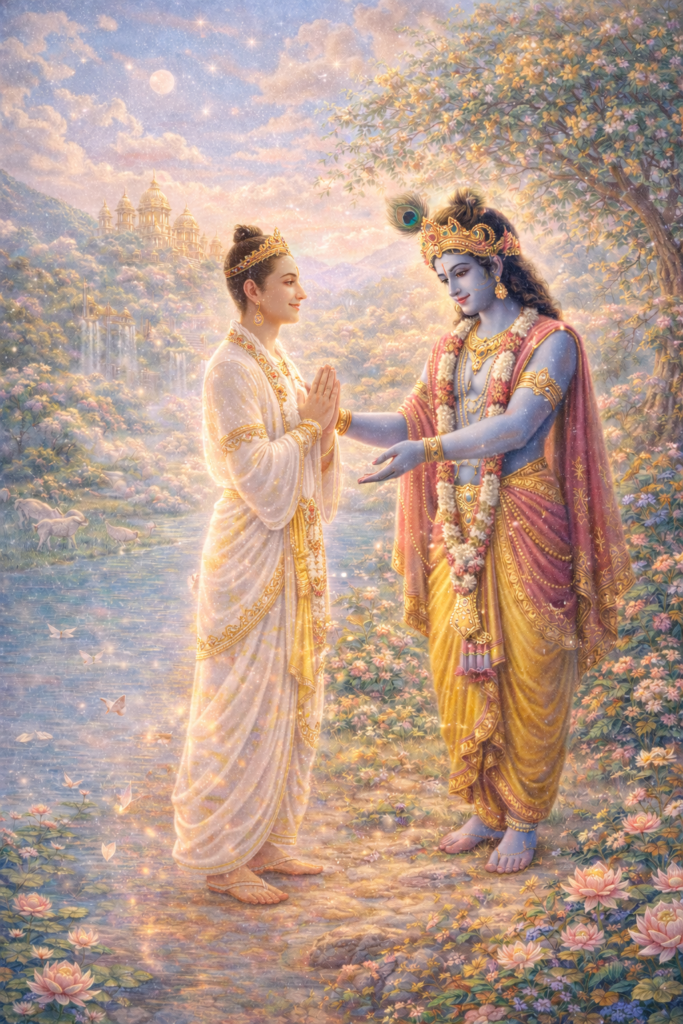
In the Bhagavad Gita, Shri Krishna offers the ultimate assurance: for the soul that completely surrenders (Saranagati), He personally destroys the mountain of Paap and Punya accumulated across eons. He bestows Moksha not as a calculated reward, but as a gift of Grace, customized to the devotee’s deepest heart’s wish—whether that be eternal service or total absorption.
Conclusion: Beyond the Mrityu Loka
Moksha remains the most profound subject of our Dharma precisely because it touches the eternal. It is the exit from Mrityu Loka (the world of death) and the entry into the Unchanging. Whether one seeks the silence of Sayujya or the sweetness of Bhakti, the path begins with unlearning the myths and ends with the Grace of the Almighty.