Introduction:
The Meaning of Dharma Why it Matters?
Few words in human civilization carry as much depth and philosophical significance as the Sanskrit word Dharma. Yet paradoxically, it is also one of the most misunderstood concepts today. In modern discussions the word is often translated as “religion,” but this translation does not capture the true scope and meaning of Dharma within the wisdom traditions of Sanatan civilization.
In the Vedic worldview, Dharma does not merely refer to a belief system, a ritual practice, or membership in a religious group. Instead, it refers to the fundamental principles that sustain life, maintain order in the universe, and guide human conduct toward harmony and spiritual growth.
Understanding Dharma is essential for understanding the entire framework of Sanatan philosophy. The teachings of the Vedas, Upanishads, Puranas, and the Bhagavad Gita all rest upon the concept of Dharma. Without grasping what Dharma truly means, it becomes difficult to appreciate the deeper purpose of these scriptures and the philosophy they convey.
In Sanatan tradition, human life has four fundamental goals known as the Purusharthas: Dharma, Artha, Kama, and Moksha. Among these four, Dharma stands first because it provides direction and balance to the other three. When Dharma is properly understood and practiced, wealth and desires remain balanced and ultimately lead the individual toward the highest goal of life—spiritual liberation.
Dharma: The Principle That Sustains the Universe
The Sanskrit word Dharma is derived from the root “धृ” (dhṛ), which means to sustain, to support, or to uphold. From this perspective, Dharma can be understood as that which sustains existence and maintains the harmony of the universe.
In nature every entity has an intrinsic property that defines its function. Fire has the property of heat. Water possesses the quality of coolness and fluidity. The sweetness of sugar is its natural characteristic. These inherent qualities represent the Dharma of those substances.
Similarly, human beings also possess a natural Dharma. Truthfulness, compassion, self-discipline, and righteousness are considered the natural qualities that sustain human society and promote harmony in life.
Thus Dharma is not a concept invented by human beings. It represents the natural order embedded within existence itself. Just as physical laws govern the material universe, moral and spiritual principles govern human life and social harmony.
This understanding reveals why Dharma cannot be limited to the meaning of religion. Religions may represent belief systems or traditions followed by communities, but Dharma refers to universal principles that apply to all beings and operate throughout creation.
Dharma and the Four Purusharthas
Sanatan philosophy explains that human life is guided by four fundamental pursuits known as the Purusharthas:
Dharma – righteous conduct and the principles of harmony
Artha – wealth, resources, and material well-being
Kama – desires, emotions, and the enjoyment of life
Moksha – liberation from the cycle of birth and death
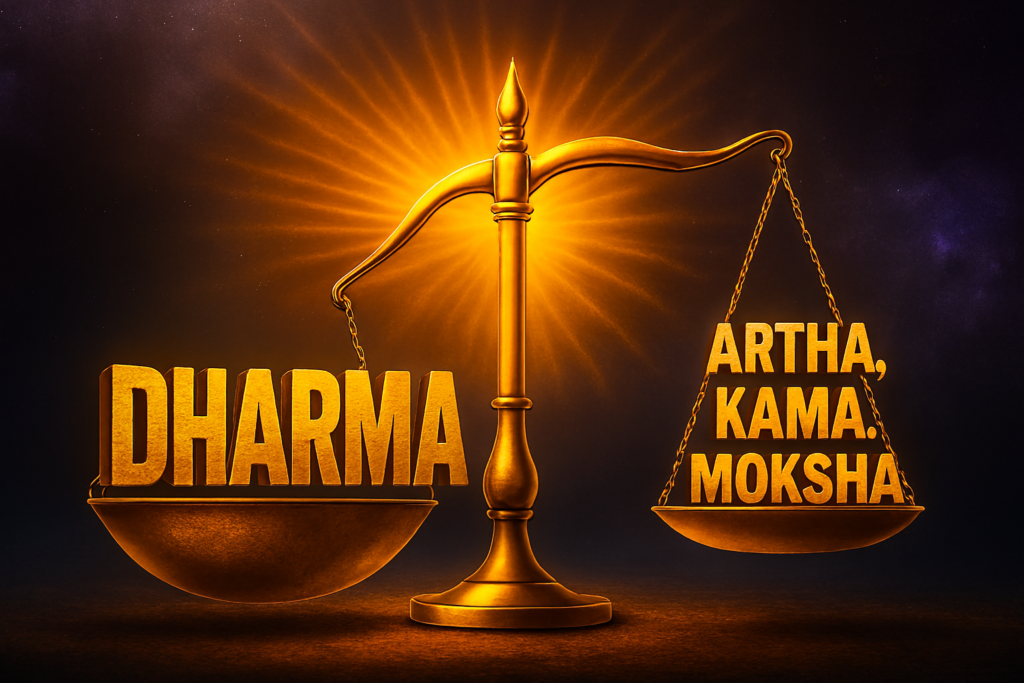
Among these four, Dharma occupies the foundational position. Artha and Kama are natural aspects of human life and are not rejected in the Vedic worldview. Human beings require material resources for survival, and they naturally experience desires and emotional aspirations.
However, Sanatan wisdom emphasizes that both wealth and desires must remain guided by Dharma.
When wealth is acquired through dishonesty, exploitation, or injustice, it ultimately leads to conflict and suffering. Likewise, when desires are pursued without restraint or moral awareness, they create imbalance within the individual and society.
But when Artha and Kama are pursued in accordance with Dharma, they contribute to a balanced life. Wealth becomes a tool for sustaining society and supporting noble actions, while desires remain aligned with ethical and spiritual values.
Through this balanced approach, the human mind gradually becomes purified and prepared for the pursuit of the highest goal—Moksha, liberation from ignorance and suffering.
The Real Purpose of Human Life
One of the most profound insights of Sanatan philosophy is that the ultimate purpose of human life is not merely material success or sensory pleasure. While prosperity and happiness are part of life, they are not its final objective.
The Bhagavata Purana explains this beautifully by stating that Dharma should not be practiced merely for the sake of acquiring wealth, and wealth itself should not be pursued solely for sensory enjoyment. Even pleasure is not meant merely for the gratification of the senses.
Instead, the true purpose of human life is tattva-jijnasa, the inquiry into the ultimate truth of existence.
This inquiry begins when a person starts reflecting upon deeper questions such as: Who am I? What is the nature of the universe? What is the source of consciousness? What is the purpose of life?
When a person lives according to Dharma, the mind gradually becomes calm, disciplined, and pure. This mental clarity enables deeper reflection and spiritual inquiry. Through knowledge and contemplation, one begins to realize the true nature of the self.
This realization leads to Moksha—the liberation from ignorance and the cycle of repeated birth and death.
The Characteristics of Dharma in Human Conduct
Ancient scriptures describe numerous virtues that reflect the presence of Dharma in human conduct. These virtues form the ethical foundation of a harmonious society.
The Manusmriti identifies ten important characteristics of Dharma: patience, forgiveness, self-control, non-stealing, purity of body and mind, control of the senses, wisdom, knowledge, truthfulness, and absence of anger.
Similarly, the Bhagavata Purana describes a larger set of qualities associated with Dharma. These include compassion, austerity, simplicity, humility, devotion, contentment, service to saints and teachers, and sharing resources with others in a spirit of generosity.
These virtues demonstrate that Dharma is not merely a philosophical idea. It is a practical way of living that shapes human character. When individuals cultivate these qualities, they contribute to peace within themselves and harmony within society.
Dharma and the Laws of Nature
Another way to understand Dharma is by comparing it with the laws of nature. Nature operates according to precise and consistent principles. The earth moves in its orbit, seasons follow predictable cycles, and seeds produce plants according to their inherent nature.
Human life also operates within a similar moral and spiritual framework. Actions motivated by greed, hatred, or selfishness eventually produce suffering and instability. In contrast, actions guided by truth, compassion, and self-discipline lead to harmony and well-being.
This universal moral order can be understood as Dharma in action. It represents the alignment of human behavior with the deeper principles governing life and existence.
Thus Dharma is not merely a set of external rules imposed upon society. It is a reflection of the natural balance that sustains the universe.
Why the Term “Sanatan Dharma” is Used
In ancient times the word Dharma itself was sufficient to describe the universal principles guiding human life. However, as different belief systems and philosophical traditions developed across the world, the need arose to distinguish the timeless Vedic understanding of Dharma from historically developed doctrines.
To emphasize its eternal and universal nature, the term Sanatan Dharma came into wider use.
The word Sanatan means eternal, timeless, and without beginning or end. It refers to principles that remain valid across all ages and civilizations.
Therefore, Sanatan Dharma is not limited to a particular period of history or a single community. It represents the eternal wisdom that recognizes the unity of existence and guides humanity toward harmony and spiritual realization.
Dharma and the Journey Beyond This Life
Sanatan teachings emphasize that the consequences of human actions extend beyond the physical lifetime of the body. While material possessions and social status remain behind after death, the effects of one’s actions continue to accompany the individual soul.
Wealth remains on earth, family members accompany a person only to the cremation ground, and the physical body ultimately returns to the elements of nature. Yet the ethical and spiritual consequences of one’s actions continue beyond this life.
For this reason Dharma is considered the true companion of the soul. A life lived according to Dharma leads to inner peace, spiritual growth, and favorable conditions for further progress on the path of liberation.
Conversely, actions driven by ignorance and selfishness create obstacles and suffering.
This perspective encourages individuals to live responsibly and ethically, recognizing that every action contributes to the shaping of their future.
Dharma and Spiritual Evolution
The ultimate purpose of Dharma is the gradual transformation of human consciousness. When a person lives according to Dharma, the mind becomes purified and balanced. Desires become moderated, emotions become refined, and clarity of thought emerges.
As this inner purification deepens, the individual begins to perceive the deeper reality underlying existence. The self is recognized not merely as the body or the mind but as a conscious presence beyond both.
Sanatan philosophy describes this realization as the discovery of the self as Sat-Chit-Ananda—pure existence, pure consciousness, and pure bliss.
This realization represents the culmination of the human journey and the attainment of Moksha, the ultimate liberation from ignorance and suffering.
Conclusion: Dharma as the Path to Harmony and Liberation
Dharma is far more than a set of rituals or a cultural identity. It is the timeless wisdom that sustains harmony within the individual, society, and the cosmos.
By guiding human conduct through principles such as truth, compassion, self-discipline, and responsibility, Dharma creates the foundation for a balanced and meaningful life. It allows wealth and desires to exist within ethical boundaries while preparing the mind for deeper spiritual understanding.
When Dharma guides Artha and Kama, life becomes balanced. When knowledge arises through Dharma, the path to Moksha opens naturally.
In essence, Dharma acts as the eternal compass of life, guiding humanity from disorder toward harmony, from ignorance toward wisdom, and from bondage toward liberation.
Understanding Dharma, therefore, is not merely an intellectual exercise. It is the beginning of a journey toward a life of purpose, balance, and spiritual realization.