Purpose of This Article Series
To feel curiosity about the Vedas is a blessing for every Hindu. However, that curiosity must be guided by authentic scriptural understanding. In the present age of information overload, where data is abundant but wisdom is scarce, numerous misconceptions about the Vedas circulate widely in society.
This article series titled “What Are Vedas?”, will unfold the basics of Vedic teachings relevant for our generation and “must to know” knowledge areas by Hindu’s in about 25 parts. This series does not intend to teach the chanting of Vedic mantras. Such a task cannot be undertaken casually. The Vedas are not an ordinary body of knowledge that can be learned independently through books or casual reading. They are meant to be tought the traditional Guru-mukha parampara (teacher-disciple oral tradition). Attempting to perform mantra practices merely by reading commercially available mantra books is not only against tradition but also a violation of the discipline prescribed in the scriptures.
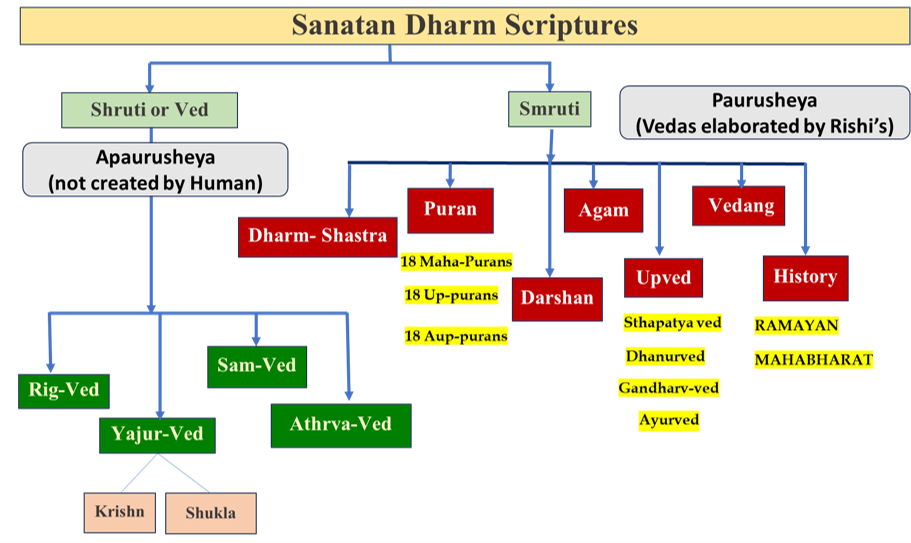
The purpose of this series is therefore very specific: to introduce the ordinary Hindu reader to the eternal foundation upon which the entire structure of Sanatan Dharma rests. All our scriptures—Shastras, Puranas, Smritis, and philosophical systems—derive their authority and inspiration from the Vedas.
Today, the spiritual space is crowded with half-understood interpretations, speculative theories, and misleading narratives presented under the label of “Vedic science.” In this age of confusion, where self-proclaimed experts frequently distort Vedic knowledge, it becomes essential to understand the authentic dignity, terminology, and structure of the Vedas—concepts such as Kalpa, Nirukta, Chhandas, Brahmana, and Upanishads.
In the forthcoming articles, we will explore the profound principles and sacred disciplines associated with the Vedas. The aim is to awaken discernment so that readers may distinguish between truth and misconception, rediscover the grandeur of their cultural heritage, and remain firmly rooted in authentic dharmic wisdom.
Before entering the vast ocean of Vedic knowledge, however, it is essential to first understand the immense scope and expanse of the scriptural literature of Sanatan Dharma. That foundation has been explained in detail in the following article available in Hindi and English both in different sites:
Hindi – https://dharmsanatan.com/how_-vast_are-sanatan-dharm-scriptures/ and
English – https://bhavambhavaani.com/how-vast-is-sanatan-dharm-hinduism-literature/
The Vedas: An Eternal Ocean of all Knowledge
Vedas are the most precious intellectual and spiritual treasure of human civilization. The lofty and universal principles contained within them have inspired thinkers and seekers across generations.
It is said that one who truly understands the Vedas understands everything, because whatever is worth knowing about existence ultimately finds its foundation within them.
Meaning of “Exalted Principles”
The principles described in the Vedas are often called “udātta” (exalted). This term refers to ideas that are noble, pure, and elevated—principles that transcend narrow limitations such as caste divisions, sectarian boundaries, or personal interests. Such teachings aim at the welfare of the entire cosmos.
These Vedic truths are not temporary philosophical opinions or material observations. They are eternal realities without beginning or end, timeless truths that remain valid across all ages.
The Vedas Are Not Human Compositions
The Vedas are not ordinary books written by human authors. According to the declarations of the ancient sages:
“Vedo Nārāyaṇaḥ sākṣāt” — The Vedas are the direct manifestation of Lord Narayana Himself.
Divine Breath of the Supreme
Just as breathing is a natural process for human beings, the Vedas are described as the divine breath of the Supreme Being.
Apaurusheya – Not of Human Origin
The Vedas are called Apaurusheya, meaning they have no human author. They are not inventions or intellectual creations but eternal knowledge revealed by the Supreme only to the worthy.
Misconceptions of Historians
Some modern historians attempt to date the Vedas to a few thousand years in the past. According to the traditional understanding, this approach is fundamentally flawed. The Vedas are Anadi (without beginning) and Nitya (eternal). Even Lord Brahma is not their creator; at the beginning of creation, the Supreme Lord reveals this knowledge within Brahma’s heart.
The extraordinary knowledge that once allowed ancient India to guide and influence the world—its sciences, philosophy, and spiritual insight—was derived from the Vedas. Through this divine knowledge, the sages realized the ultimate truth and established pathways that led humanity toward prosperity, harmony, and peace.
Vedas: The Source of All Knowledge and Dharma
The Vedas form the foundational source of Indian culture and spiritual philosophy. They contain teachings that guide both worldly life (this world) and spiritual destiny (the next world).
The scope of the Vedas is astonishingly vast. Along with religious principles, they address on every subject that we know of in our planet and also many others that we do not know: some of the important subjects relevant for daily living and Dharm are as follows:
- ethics and social conduct
- spiritual discipline
- knowledge and science
- arts and crafts
- technical and industrial skills
There is virtually no domain of life that the Vedas do not address.
A remarkable aspect is that many principles underlying modern scientific discoveries can also be traced to Vedas. Because of this comprehensive nature, the Vedas are regarded as the eternal foundation of all knowledge and wisdom.
For this reason, sages have described the Vedas as the inexhaustible ocean of knowledge and the root of all dharma.
Manusmriti on the Authority of the Vedas
The sage and King Shri Manu Ji declared:
“Vedo’khilo dharmamūlam”
— The Vedas are the ultimate source / foundation of all dharma.
He further states:
“Chaturvarnyam trayo lokāś chatvāraś chāśramāḥ pṛthak
Bhūtam bhavyam bhaviṣyam cha sarvam vedāt prasidhyati.”
(Manusmriti 12.97)
This verse explains that the organization of the four social orders (Brahmana, Kshatriya, Vaishya, and Shudra), the three realms of existence, and the four stages of life (Brahmacharya, Grihastha, Vanaprastha, and Sannyasa) all originate from the Vedas. Past, present, and future religious duties are also established according to Vedic knowledge.
The Brihadaranyaka Upanishad states:
“Rigveda, Yajurveda, Samaveda, and Atharvaveda emerged from the breath of the Supreme Being.”
Similarly, the Aitareya Brahmana declares that Prajapati revealed the Vedas for the welfare of all beings.
All scriptures—including the Upanishads, philosophical systems, Puranas, and Dharmashastras—ultimately rest upon the authority of the Vedas. True knowledge of the soul, the universe, nature, and the Supreme Being is contained within them.
To understand the Vedas is therefore to understand the very essence of existence.
Being Compassionate towards Kaliyuga Inhabitants Maharishi Vedavyasa Divided the Vedas
Originally, the Veda was Only One. Toward the end of the every Dvapara Yuga, Lord Narayana appears as Krishna Dvaipayana Vedavyasa (an Avtar of Shri Vishnu).
Knowing that the people of the coming Kali Yuga would have shorter lifespans, weaker memory, and reduced intellectual capacity, he divided the Veda into four sections for easier preservation and study.
These divisions are:
- Rigveda
- Yajurveda
- Samaveda
- Atharvaveda
This historic act is mentioned in the Mahabharata, where Vedavyasa is praised for expanding the Veda into four parts.
He taught these Vedic divisions to his principal disciples:
- Paila — Rigveda
- Vaishampayan — Yajurveda
- Jaimini — Samaveda
- Sumantu — Atharvaveda
Later, after the Mahabharata war, Vedavyasa composed the monumental epic Mahabharata, which is often referred to as the Fifth Veda. This work was taught to his disciple Lomaharshana.
Vedas are also known by other names “Shruti”, “Trayi”, “Amnaya”
Shruti
The Vedas are called Shruti, meaning “that which is heard.” Vedic knowledge is transmitted through the oral tradition where the disciple listens to the guru and memorizes the mantras through disciplined repetition and rigorous practice for correct pronunciation.
Practicing Vedic mantras solely from books without hearing them from a qualified Guru is traditionally considered improper and ineffective.
Amnaya
Because the Vedas must be preserved through dedicated practice and recitation, they are also known as Amnaya.
Trayi ( Often expressed as Ved-Trayi)
Human expression typically takes three primary forms: Poetry, Prose and Music
The Vedas contain all three forms:
- Rik – metrical poetic verses
- Yajus – prose formulations used in rituals
- Sama – melodic chants
Due to this threefold mode of expression, the Vedas are sometimes collectively called Trayi.
The term does not imply that there are only three Vedas; rather, it refers to these three styles of expression.
The Four Vedas and Their Functional Roles in Yajna
Although the Veda is fundamentally one, its division into four parts corresponds to the roles performed during a Vedic yajna.
In a Vedic sacrifice, the sponsoring individual appoints learned priests called Ritviks. These priests belong to four functional groups, each responsible for a different aspect of the ritual.
Each group specializes in one Veda.
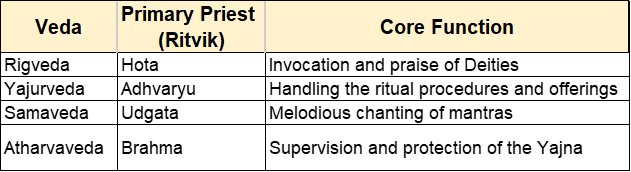
The coordinated work of these four priests ensures that the yajna is conducted correctly and successfully.
The Forgotten Discipline of Vedic Study
In the modern world, many people assume that the Vedas can be read like any other book. This assumption is dangerously wrong, Yes! Learning Veda’s require strict adherence to the Shastra guidelines lest it can be dangerous. Lets understand what are those Guidelines-
Eligibility (Adhikara)
Traditionally, Vedic study requires specific eligibility. One must undergo the Upanayana (Yajnopavita) initiation, and the student must belong to the traditional Dwija (twice-born communities) which are Brahmana, Kshatriya, or Vaishya .
Lifetimes of Spiritual Preparation
Acquiring Vedic knowledge is not considered the achievement of a single lifetime. It is seen as the fruit of continuous spiritual discipline accumulated over many births.
Guru-Shishya Tradition
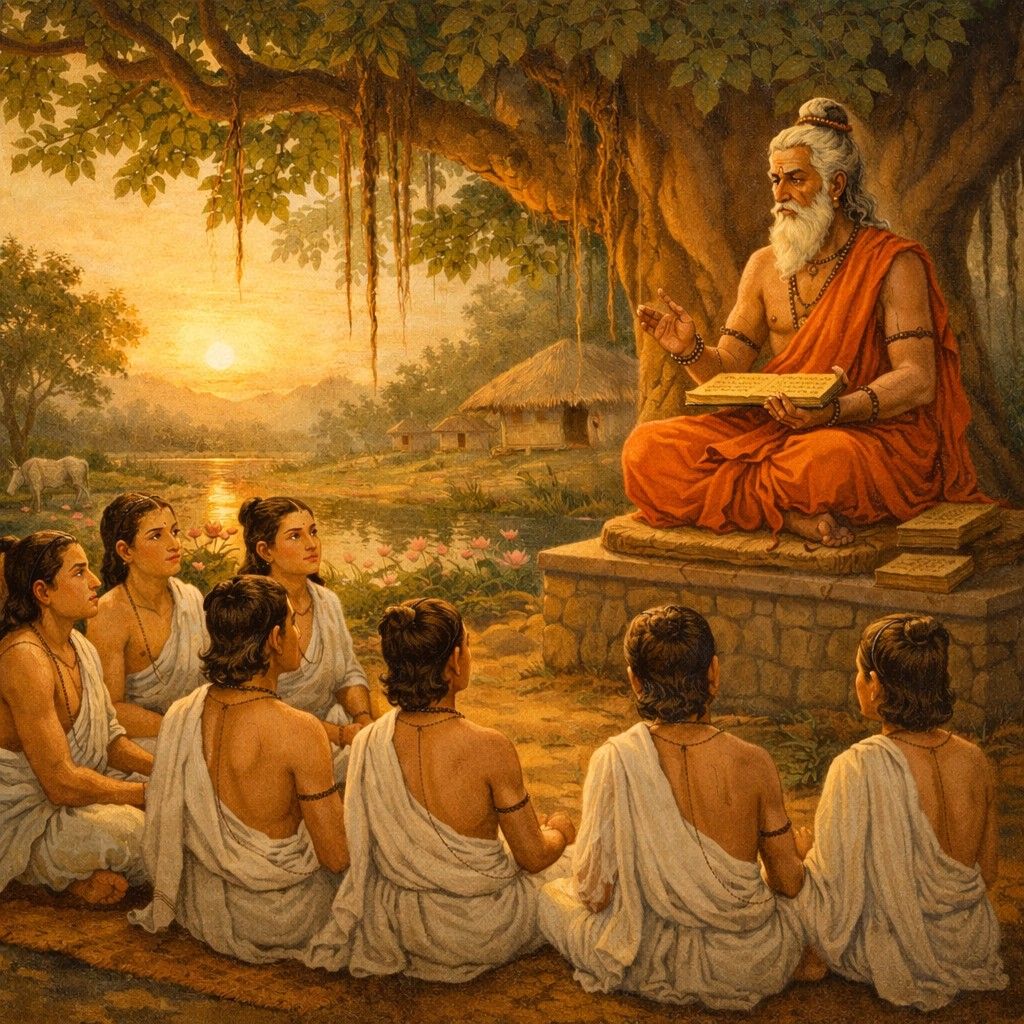
The Vedas are called Shruti because they are learned by listening. Sitting before the guru, practicing brahmacharya, and absorbing the precise pronunciation of mantras form the core of the learning process.
Restrictions and Discipline in Vedic Study
Vedic study is governed by strict rules known as Anadhyaya.
Certain lunar dates such as Pratipada, Ashtami, and Chaturdashi prohibit Vedic recitation.
Natural disturbances such as thunder, heavy rainfall, or even the passing of an animal between the guru and disciple are considered interruptions requiring the study session to stop.
Before beginning Vedic learning, a formal ritual known as Vedarambha Sanskara is performed after the Upanayana ceremony.
Why a Guru and Eligibility Are Essential
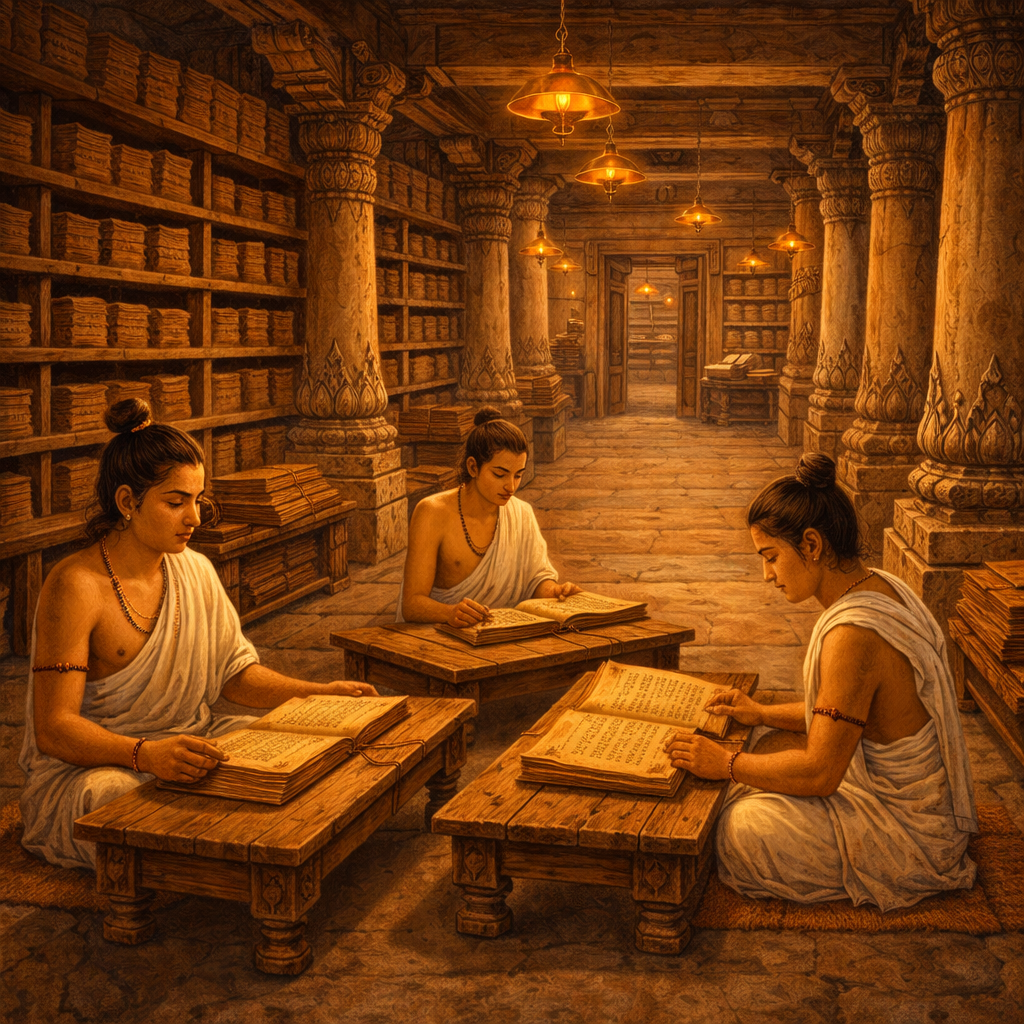
The necessity of a guru and proper qualification can be understood through following examples.
Medical Science
No person can become a doctor merely by reading medical textbooks. Formal training, eligibility criteria, and years of supervised practice under experienced physicians are essential. Similarly, learning Vedas requires a qualified Guru ( see above mentioned section titled .
Just as medicine that can heal and harm depending on proper usage, same holds true for the Veda’s as well.
Conclusion: The Beginning of a Vast Journey
In this first part of the series “What Are the Vedas?”, we have only touched upon the nature of the Vedas and the sacred disciplines associated with them. What has been presented here is merely a few drops from an infinite ocean of knowledge.
In the upcoming parts of this series, we will explore many fascinating aspects of Vedic wisdom, including:
- the profound relationship between the Vedas and the ancient Rishis and Rishikas
- the scientific significance of the six Vedangas
- the remarkable body of knowledge contained within Vedic literature
Readers interested in understanding their cultural roots and the true intellectual heritage of Sanatan Dharma are invited to continue this journey in the next part of the series.
References
- Kalyan – Ved Katha Ank, Geeta Press
- Kalyan – Dharm Shastrank, Geeta Press